Chisamba.
Thirty-five megawatts of solar for a grid that needs another source.
A grid-connected solar plant on 52 hectares north of Lusaka, with its permits, environmental approval and grid connection agreement in place, preparing for financial close.
DC capacity, 80,190 bifacial glass-glass modules
Export capacity approved by ZESCO
Specific yield, P50 simulation (PVsyst, April 2026)
Emissions avoided per year at Zambia’s grid factor
Planned term of the USD-denominated power purchase agreement
A hydro-dependent grid that has learned the cost of a dry year.
Zambia’s electricity has come mainly from hydropower. The 2023/24 drought, the worst in decades in the region, cut hydro output and brought load shedding of up to 21 hours a day in early 2024. Diversifying into solar is now national policy, and private buyers can contract power directly under the 2024 open-access regulations.
Daily load shedding at the peak of the 2023/24 drought.
Reported solar capacity in MW, 2021 to 2026.
Share of generation from variable renewables targeted by 2030 under the Integrated Resource Plan.
Sources: Afrobarometer (May 2026); industry press (2026); Integrated Resource Plan 2022, as cited in the project’s business plan.
Flat, open, close to the grid.
- Location
- Kwando village, Chief Chamuka area, Chisamba District, Central Province
- Land
- About 52 ha in three parcels; sale agreement executed in 2026, conversion of the remaining customary land to title in progress with the Chief’s consent
- Terrain
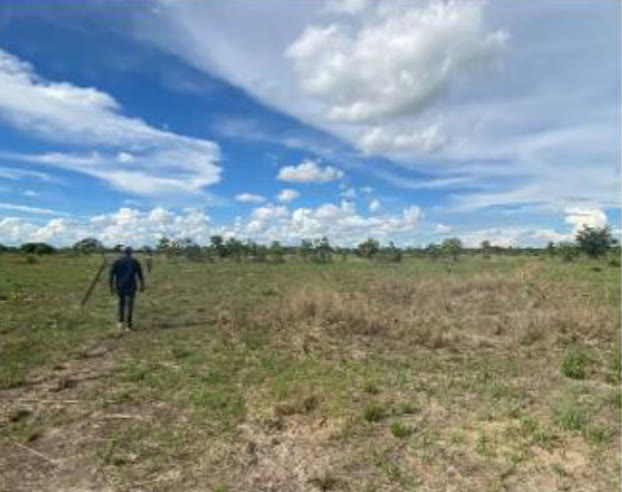
- Gently undulating plateau, slopes mostly 0–5 %; no major earthworks expected
- Land use
- Farmland with scattered shrubs; not in a protected area; no permanent structures on site
- Climate
- Subtropical savanna, mean temperature about 21 °C, rainy season November to March
- Grid
- About 6.7 km to the ZESCO Figtree 88/33 kV substation
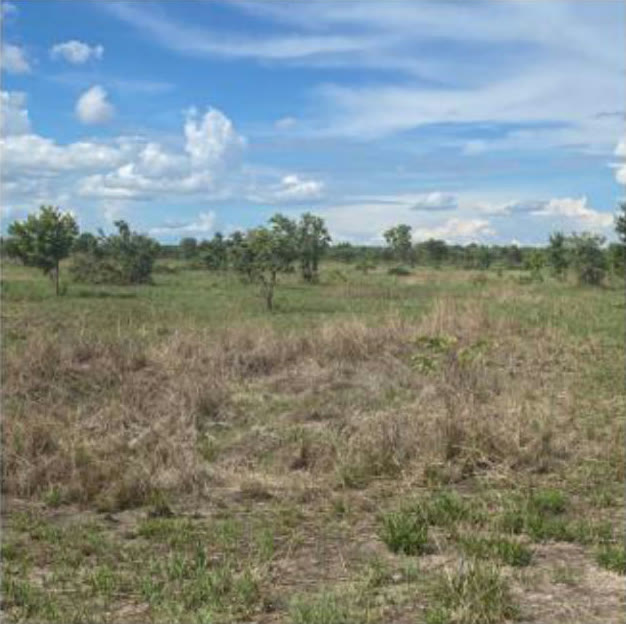
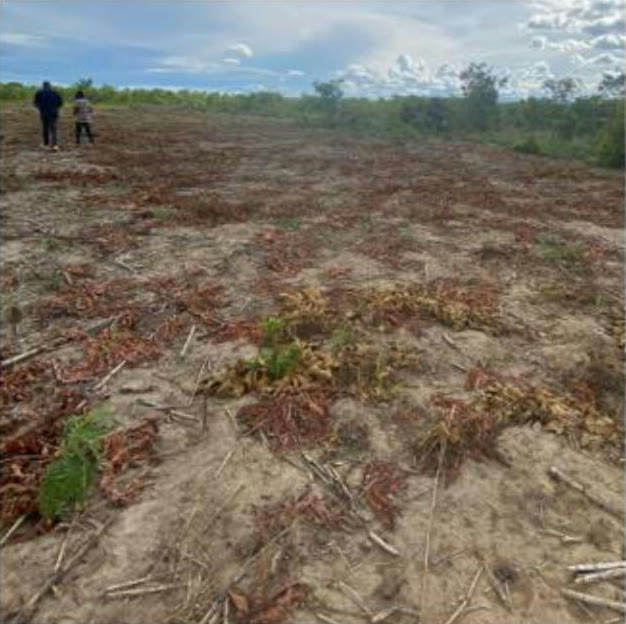
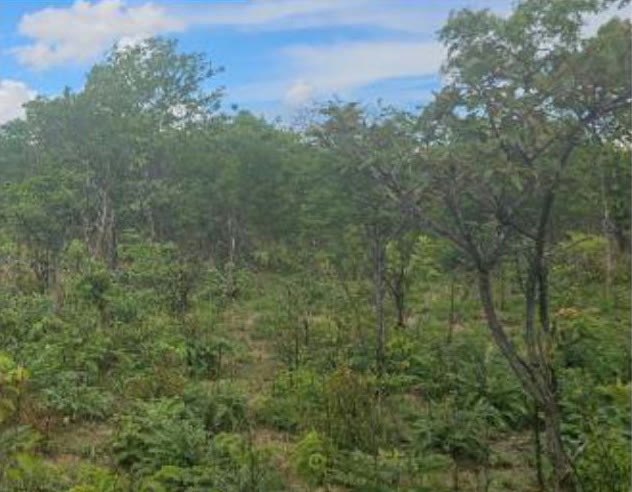
Site photographs: project feasibility study.
A conventional design, chosen to be financed.
Fixed-tilt bifacial modules on screw piles, string inverters for redundancy, and a single 88 kV line sized for the full export. Nothing in the design asks a lender to take technology risk.
- Modules
- 80,190 bifacial glass-glass monocrystalline modules, 630 Wp, 1,500 V strings
- Inverters
- 100 string inverters of the 350 kW class; export limited to 35 MWac
- DC/AC ratio
- 1.44, to use the grid limit for more hours of the day
- Mounting
- Fixed tilt 15°, facing north; screw piles, no concrete in the array
- Substation
- 33/88 kV step-up transformer, 40 MVA, equipment rated 132 kV
- Operation
- Plant SCADA with string-level monitoring, weather stations, 24/7 security
Energy to the grid by month, P50
GWhPVsyst simulation of the final design (April 2026), 91,973 MWh a year before availability; performance ratio 80.2 %. Copper bars: dry season. The financial plan uses a slightly more conservative earlier run.
Full export, studied and signed.
The line and bay equipment are rated for 132 kV because ZESCO plans to uprate Figtree to 132 kV; until then the line operates at 88 kV.
The permitting work is done. What remains is the financing.
Status as of November 2026.
- Company registration · PACRA and tax registration2025
- Environmental approval · ZEMA decision on the environmental and social impact statement, prepared to IFC Performance Standards30 June 2026
- Feasibility study · updated study approved by the Ministry of Energy21 July 2026
- Grid impact study · approved by ZESCO for 35 MWac export2026
- Grid connection agreement · executed with ZESCOJuly 2026
- Implementation Agreement · executed with the Government of the Republic of Zambia2026
- Investment certificate · Zambia Development Agency, valid until July 2031July 2026
- Land · sale agreement executed; title conversion of the remaining parcel in progress2026
- Power purchase agreement · 25-year term sheet negotiated with a private offtaker; signature after board approvaltarget Q1 2027
- Generation licence · application to the Energy Regulation Boardtarget Q1 2027
- Lender due diligence · independent technical, environmental and insurance adviserstarget Q1 2027
About fourteen months from financial close to power on the grid.
Development
Studies, permits, grid and government agreements.
Due diligence
Lenders mandated, PPA signed, licence applied for.
Financial close
Target. Procurement of long-lead items from June.
Construction
Twelve months under a fixed-price turnkey EPC contract.
Commercial operation
Target. 25 years of contracted operation to follow.
All future dates are targets from the project’s business plan (November 2026).
Measured in tonnes, and in what stays local.
First-year generation × Zambia’s grid emission factor for solar projects of 0.3057 t CO₂/MWh. The registered carbon programme will set the factor that counts.
Environmental and social impact statement approved by ZEMA, built on the IFC Performance Standards, with a management plan and grievance mechanism.
Sheep grazing inside the fence keeps vegetation down and the land in agricultural use, creating income for Kwando village.
Local labour during construction; permanent operation, maintenance and security roles; training of local technicians.
The company has applied for results-based finance to bring 1,000 solar home systems to households in Chisamba District.
Consultations held with Chief Chamuka and the traditional leadership; priorities agreed with them and the Chisamba Town Council.
German development, Zambian leadership, an EPC partner with equity at stake.
The plant will be built under a single fixed-price, date-certain turnkey contract with guaranteed performance and capacity, delay and performance liquidated damages and a performance bond. An independent owner’s engineer from Germany reviews the design for the company. Because the EPC contractor is also a shareholder, decisions on the EPC contract are reserved to directors it does not appoint.
Structured for limited-recourse project finance.
The company is raising long-term senior debt and equity for construction. The structure follows the terms of comparable solar financings in the region: a Zambian special purpose company, USD revenue under a long-term power purchase agreement, payment security for the offtake, and a standard security package for lenders.
- Permits, environmental approval, grid connection and the Implementation Agreement are in place.
- Energy yield is simulated on the final design and will be validated by the lenders’ independent engineer.
- Fixed-price turnkey construction by an EPC contractor that also holds equity in the project.
- A business and investment plan with financial model, lender cases and data-room index is available.